An AITAKY product
FarDesk — From the customer's request to the invoice.
Requests arrive by email, from your website, over chat and from your customers' own systems. Someone has to read them, work out who should handle them, and decide whether they fall inside the contract or get billed. FarDesk does that on arrival: it analyses the message, opens the ticket, assigns it to whoever has the right skill and the least open work, and says whether the contract covers it. You confirm, or correct.
0
Clicks to triage a message the AI has already analysed
3
Views on the same work: table, kanban, calendar
8
Roles with distinct permissions, customer included
The problem
Three tools that don't talk.
Anyone supporting their own customers works in a mailbox for requests, in an accounting system for invoices, in a spreadsheet for hours and contracts. And in the technician's memory for everything else.
Every email is read and triaged by hand
It's the first half hour of every morning, and it's work nobody bills.
Coverage is decided by eye
«Is this inside the contract?» is a question you answer by reopening the PDF — or by asking a colleague.
Work lands on the wrong person
Whoever assigns it doesn't know who already has too much open, nor who actually knows that customer and that product.
The hours worked never reach the invoice
An hour written as free text in a note can't be aggregated, and so can't be billed.
The customer writes just to ask where things stand
Because they have no other way of knowing.
FarDesk doesn't add a fourth tool: it replaces the chain.
The features
One request. One single file.
The inbound queue
Requests arrive where they already arrive — mail, the website form, a partner's system — and land in a queue, not straight into a ticket. Opening a file has consequences: SLAs start, notifications go out, a public number is consumed.
Automatic analysis of the message
If the customer is recognised, the ticket is born complete: rewritten subject, category, priority, summary, contract assessed, and tasks with estimated hours. The operator corrects; they don't fill forms.
Coverage is data, not a label
A contract carries its SLA, caps, included hours, covered products and coverage notes in plain language. The AI reads those notes and decides whether it really covers that request — not just whether it points at the same product.
Skill first, then workload
A task goes to whoever has the most specific skill for that customer and that product; among those people, the one with the fewest estimated hours on open tasks wins. Five half-hour tasks are not two one-day tasks.
Tasks, hours, invoice
The ticket is the request, the tasks are the work: estimate, due date, attachments, internal notes, outcome. Hours are logged on the task with a billable flag and feed the contract's hour bank. Quote and invoice grow from there.
Your customer's portal
They open a request from a public form, without registering first. Then they follow progress in readable phases, attach files, approve a quote. With your logo and your colours. Internal notes stay internal.
Inside FarDesk
The screens we use every day.
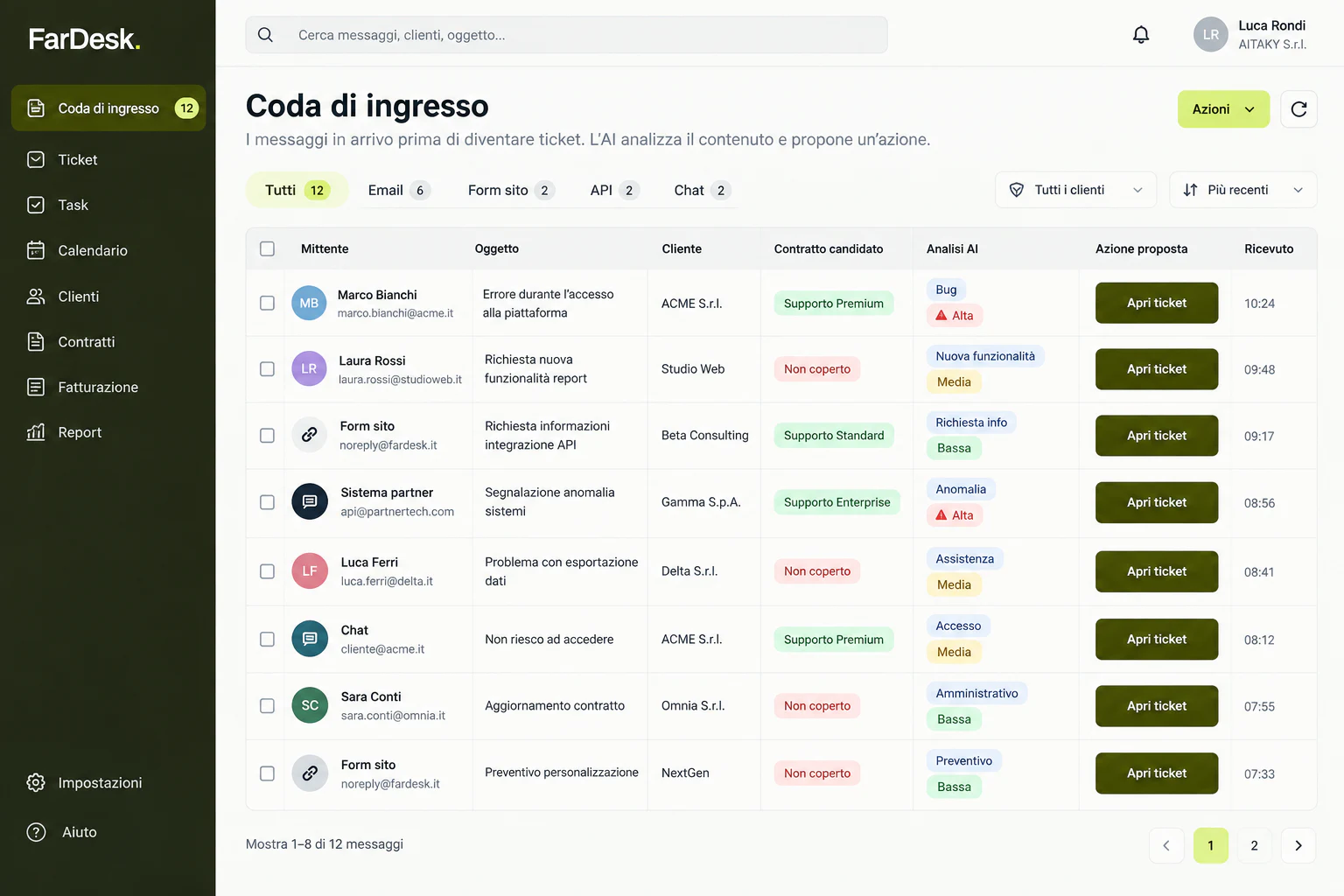
The inbound queue
Incoming messages before they become tickets: recognised sender, candidate contract, proposed action.
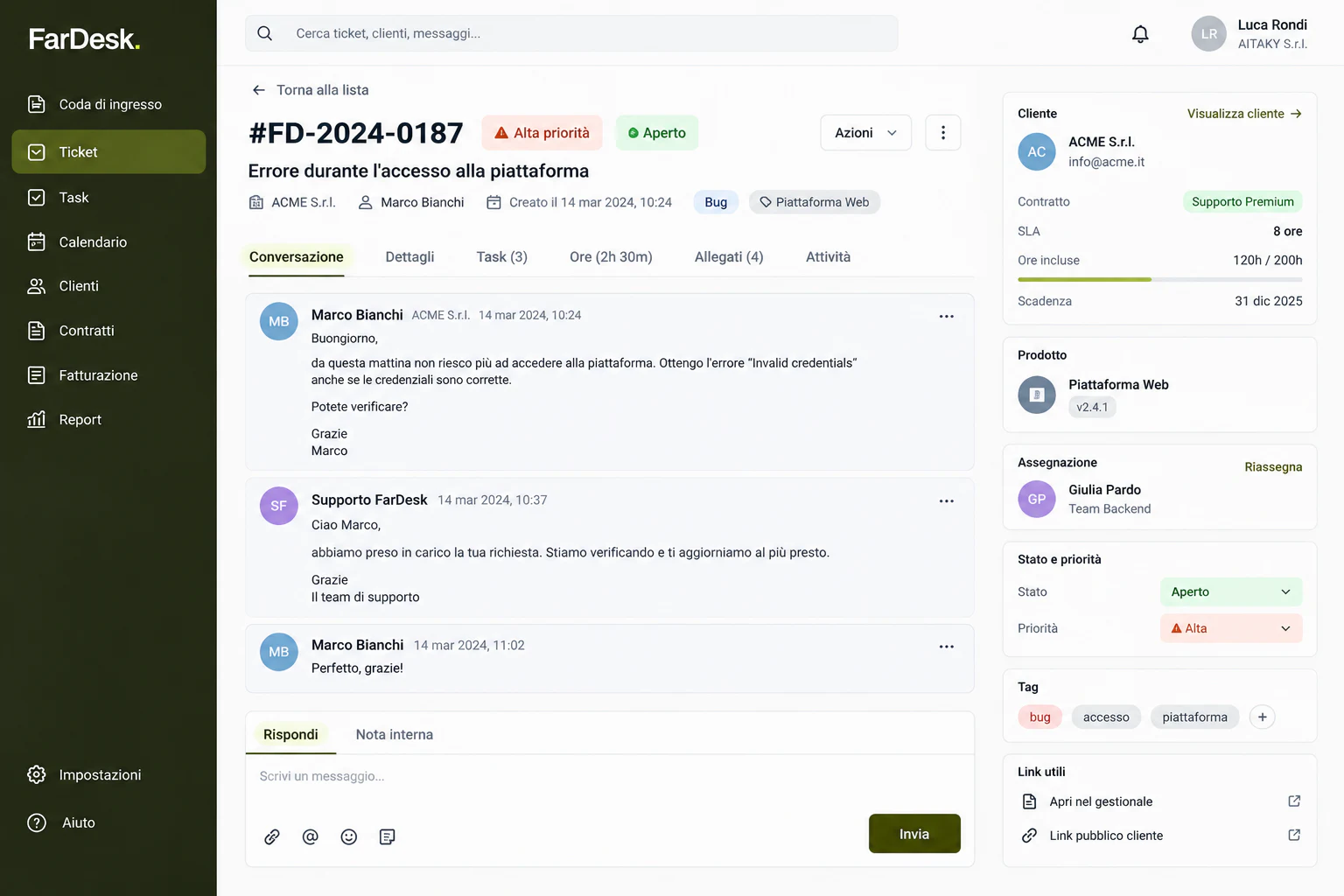
The ticket as a file
Conversation, product, contract, tasks, hours and attachments on the same page.
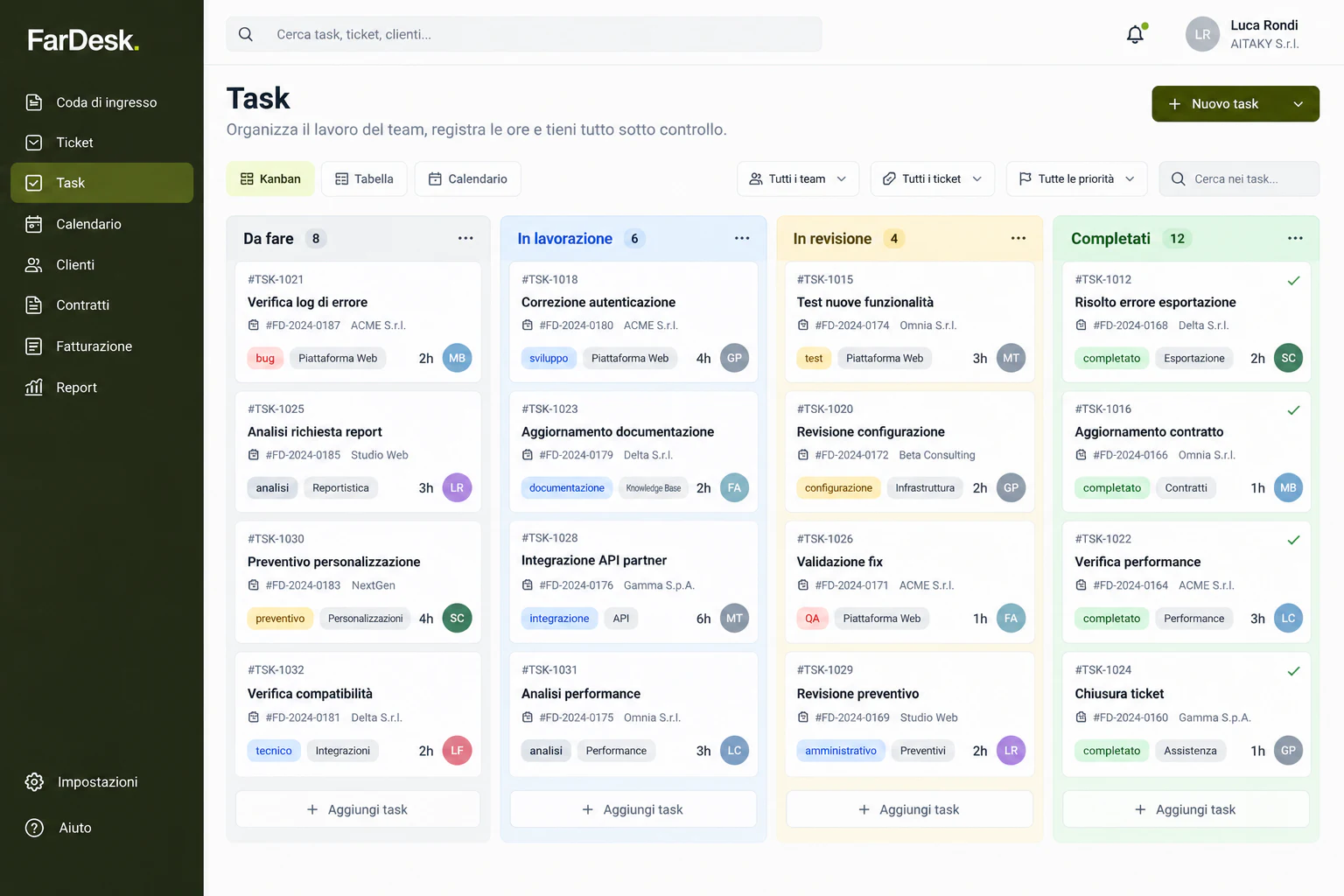
Tasks on a kanban
The same work as a table, a kanban or a calendar. Hours are logged from here.
«When in doubt, out of contract.»
The fallback when the AI can't decide
An AI that errs on the right side.
Every contract carries coverage notes in plain language — «covers bug fixing only, not new features». When a request arrives, the AI receives the candidate active contracts with their notes and decides whether one of them really covers it. When it can't decide — an error, a timeout, an ambiguous answer — the fallback is always the same: out of contract, billed separately. Never an assumed coverage. Declaring «out of contract» by mistake costs a ten-second correction during analysis; assuming coverage that isn't there costs unbilled work you notice at the end of the month.
- The body of a message is data to analyse, not instructions to execute.
- An id returned by a model is never believed: the proposed contract must match one of those actually put forward.
- An AI failure never blocks the work: at worst the ticket is created without the enrichment.
Open to the outside
Not a closed box with a single interface.
Inbound API
A POST with the tenant key drops a message into the queue, with idempotency and a conversation id: the same message delivered twice doesn't become two tickets, and replies in a thread don't open a new file.
MCP server
You generate a key, read-only or read-write, and a compatible AI assistant queries tickets, customers, contracts, hours and analytics. «How many open tickets does this customer have, and how many hours have we spent?» becomes a question, not a report you commission.
Bot on chat, Telegram, Slack, and more
Events land in the channel where the team already talks, and you can ask the bot right there in the chat. Write actions never run in the same round in which they're proposed: they ask for an explicit confirmation.
Webhooks and events
Every mutation writes an event with a stable name and payload — ticket.created, status.updated, invoice.issued — ready to wire into your ERP or an external dashboard. The same log records AI usage: calls, tokens, model.
How you adopt it
Six steps, side by side.
We bring your data in
Customers, products, plans and contracts currently running.
We configure your taxonomy and the team's skills
Your categories, and who knows how to do what: that's what drives automatic assignment later.
We connect the channels
Requests keep arriving where they already arrive, and land in a single queue.
We switch the automatic analysis on
Side by side at first, with the operator correcting. Then on its own, on the cases it closes well.
We open the portal to your customers
With your logo, once the rest works.
We connect the rest
Webhooks into your ERP, the bot in the team's channel, the MCP server for whoever wants to query the data by talking.
Why we believe in it
«We use it ourselves, every day, on our own customers. If something breaks, we notice before you do.»
FarDesk is the software AITAKY runs its own support on: the tickets of the customers using our products go through here every day. It's the strongest proof we have, and the only one we can offer right now.
Frequently asked questions
Everything worth knowing about FarDesk.
Who is FarDesk for?+
For SMEs that sell a product or a service and have to support whoever uses it: product companies, businesses repairing under warranty, anyone working with a support contract. Several customers, several products, contracts with different perimeters, requests arriving from email, forms and third-party systems.
What does the AI do, and what stays with the operator?+
The AI reads the incoming message, rewrites the subject, sets category and priority, summarises, assesses which contract covers it and proposes the tasks with estimated hours. A ticket doesn't leave the analysis stage until assignee, hours and payer have been confirmed by a person.
And when the AI gets it wrong?+
On coverage it errs on the right side: when it can't decide it declares «out of contract», which costs a ten-second correction. On everything else the operator corrects during analysis. And if the AI doesn't answer at all, the ticket is created without the enrichment: the work never stops.
Do my customers have to register?+
No. They open the request from a public form and verify their address with a code by email the first time. From the portal they follow progress in readable phases — not the internal states —, attach files and approve or reject quotes.
Does it connect to the system I already use?+
Yes, through webhooks on the events (ticket created, status updated, invoice issued) and through a versioned inbound API for requests coming from third-party systems. There's also an MCP server, if you want to query the data with an AI assistant.
Is FarDesk an AITAKY product?+
Yes. FarDesk is one of AITAKY SRL's proprietary products, built for SMEs that sell a product or a service and have to support the people using it. It's the same platform we run our own customer support on, every day.
We'll show you how it works on your own contracts.
Half an hour, your real cases, no slides. If FarDesk isn't the right thing for you, we'll be the ones to say so.
Need something different? Explore custom development